There is a moment most cyclists have had. You walk past your bike in the hallway, see it properly for a second rather than just stepping around it, and think, that is a genuinely beautiful object. Then you go back to treating it like something that lives on the floor.
A bike is one of the best designed things most of us own. Someone agonised over the line of the top tube, the colour, the way the whole thing sits. And yet the default is to hide it behind a door or wedge it in a corner, as if it were an ironing board. Putting it on the wall is not just tidier. Done with a little thought, it turns the bike into the piece of the room people actually comment on. Here is how to do that properly.
// Storage and display are not the same thing
It helps to be clear about what you are aiming for. Getting a bike off the floor is a storage problem, and almost any hook solves it. Making the bike look good on the wall is a display problem, and that is a different craft entirely.
The difference is intent. A bike shoved onto a hook in a dark corner reads as storage, because it looks like it ended up there. The same bike, hung level, at the right height, on a wall chosen for it, reads as a decision. Your eye can tell the difference instantly even when you cannot say why. Everything below is about tipping the bike from the first category into the second.
// Choose the wall before anything else
The single biggest factor is which wall you pick, and most people get this wrong by defaulting to wherever is convenient rather than wherever looks best.
A bike on display wants to be seen, so give it a wall with some room around it rather than a cramped nook. A clear stretch above a sideboard, the long wall of a hallway, the space behind a sofa, or a feature wall that already draws the eye. The bike becomes the thing on that wall, so you want a little breathing space around it rather than a clutter of frames and shelves competing for attention.
Colour matters more than people expect too. A pale frame pops beautifully against a dark or deep colour wall, and a dark frame stands out against white or a soft neutral. If you happen to be repainting anyway, a single feature wall behind the bike is the cheapest way to make it look deliberate.
// Height and eye-line are everything
This is the detail that separates a display from a bodge, and it is the one people most often get wrong.
For a bike you want to show off, aim to hang it roughly at eye level, so the frame sits in the natural line of sight as you walk into the room. Too high and it floats awkwardly near the ceiling like something being stored out of the way. Too low and it reads as clutter. Around eye level, centred on its wall, it looks composed.
There is a balance to strike with practicality, of course. If it is a heavy bike you lift down often, you may want it a touch lower to save your back, which we get into in our (guide to choosing the right mount). But for a best bike that mostly stays on show, trust the eye-line over convenience.
// Level, always level
Nothing undoes the whole effect faster than a bike hanging at a slight angle. The eye is ruthless about this. A frame that droops nose down or tail up looks like a mistake, no matter how nice the bike or the wall.
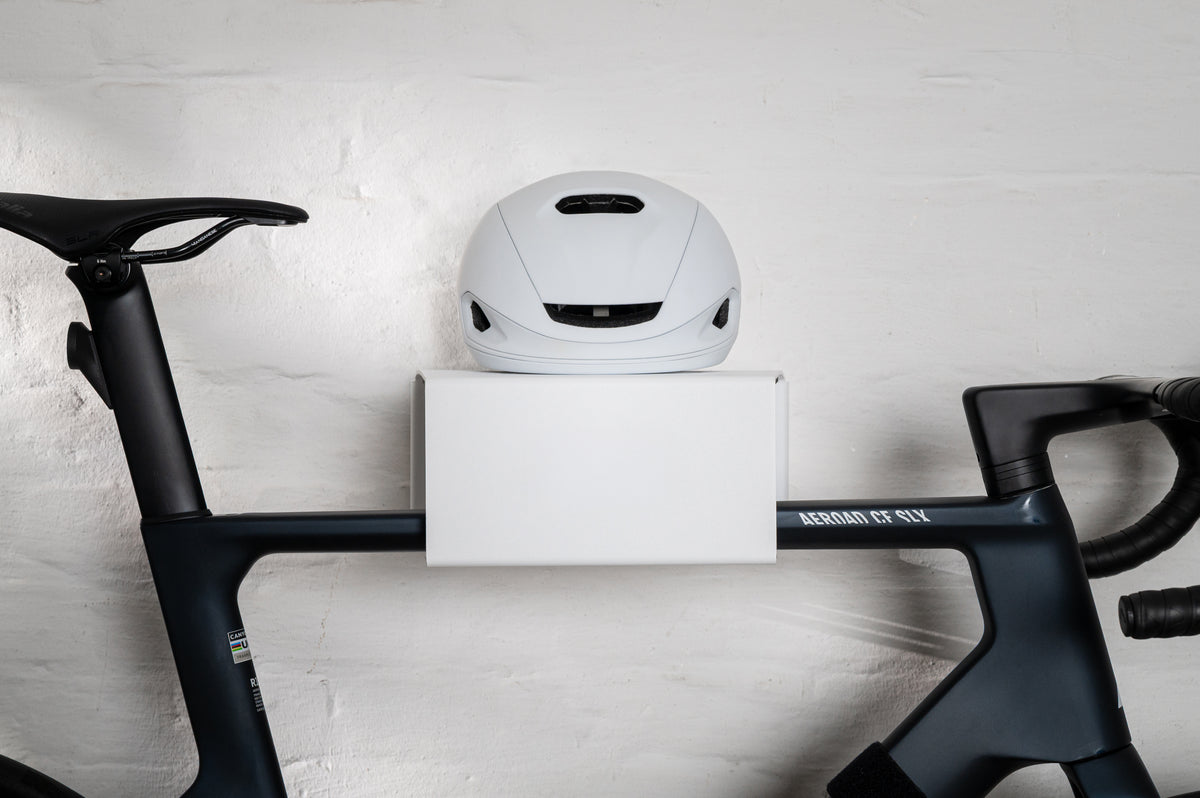
The catch is that most modern frames slope, so they will not hang level on a fixed mount on their own. This is worth getting right rather than living with, and it is the entire reason the HMB Tilt Mechanism exists. It lets you set the mount to your frame so the bike hangs perfectly horizontal whatever its geometry, which we explained in full in our piece on (hanging a bike with a sloping top tube). For a display, level is not a nice to have. It is the whole thing.

// Let the mount disappear, or make it part of the look
A bike on the wall has two visible elements. The bike, and the thing holding it. The best displays handle the mount in one of two ways, and both beat a clunky bracket shouting for attention.
The first is to let it disappear. A clean, screwless mount in a finish that blends into the wall lets the bike do all the talking, which is exactly why HMB mounts are built with a screwless face and a minimal profile rather than a cage of visible hardware.
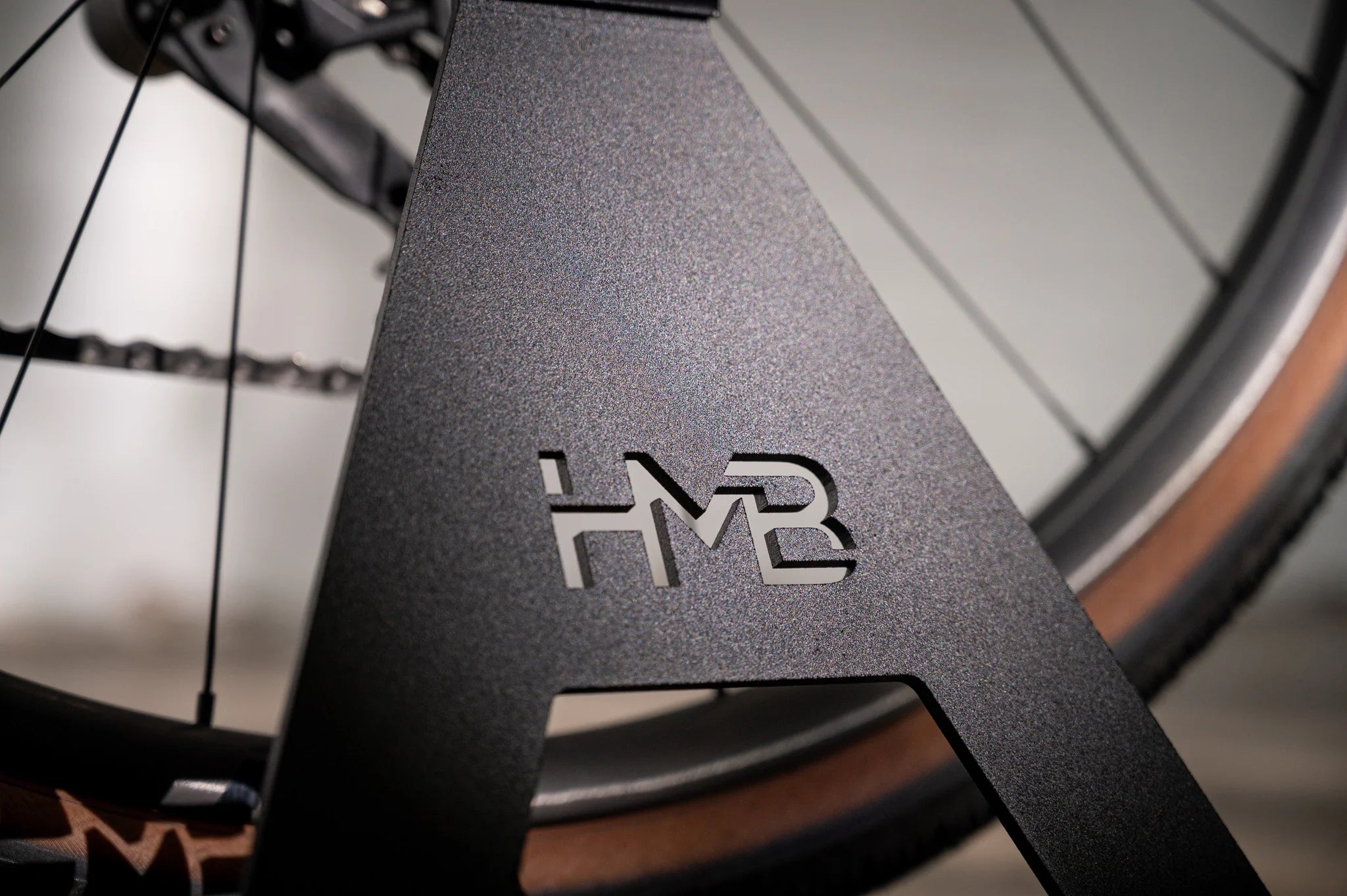
The second is to make the mount part of the statement. A name, a club or a short message laser-cut into the front plate through HMB Custom turns the mount itself into a considered detail rather than a necessary evil, in the same way a good frame finishes a painting. Choose a Jet Black or Signal White plate to suit the wall and it becomes part of the composition.

// The finishing touches
A few small things lift a bike on the wall from nice to genuinely styled.
Keep the area around it calm. A bike is a busy, detailed object, so it looks its best with some quiet space around it rather than fighting other pictures and shelves for attention. Think of it as the hero of that wall.
Consider light. A bike catching a bit of natural light, or a nearby lamp picking out the frame in the evening, looks far richer than one lost in a shadowy corner. You are lighting it a little like you would any other piece you were proud of.
And show one bike, not three. If you own several, a single beautiful bike on display beats a crowded rack every time. Rotate which one is up as the mood or the season takes you, and keep the rest stored more practically elsewhere.
// The bike you ride, on show
The lovely thing about displaying a bike rather than framing a print is that it is not just decoration. It is the actual bike you ride, off the floor, protected, easy to reach, and looking like it belongs in the room. You get the practical win and the beautiful object in one.
That is really what Hold My Bike is for. A mount that holds the bike you love securely and safely, in 3 mm steel made in the EU, while letting it be seen the way it deserves. Your bike is already a beautiful thing. This is simply giving it somewhere worthy to live.
Greetings from Vienna.